
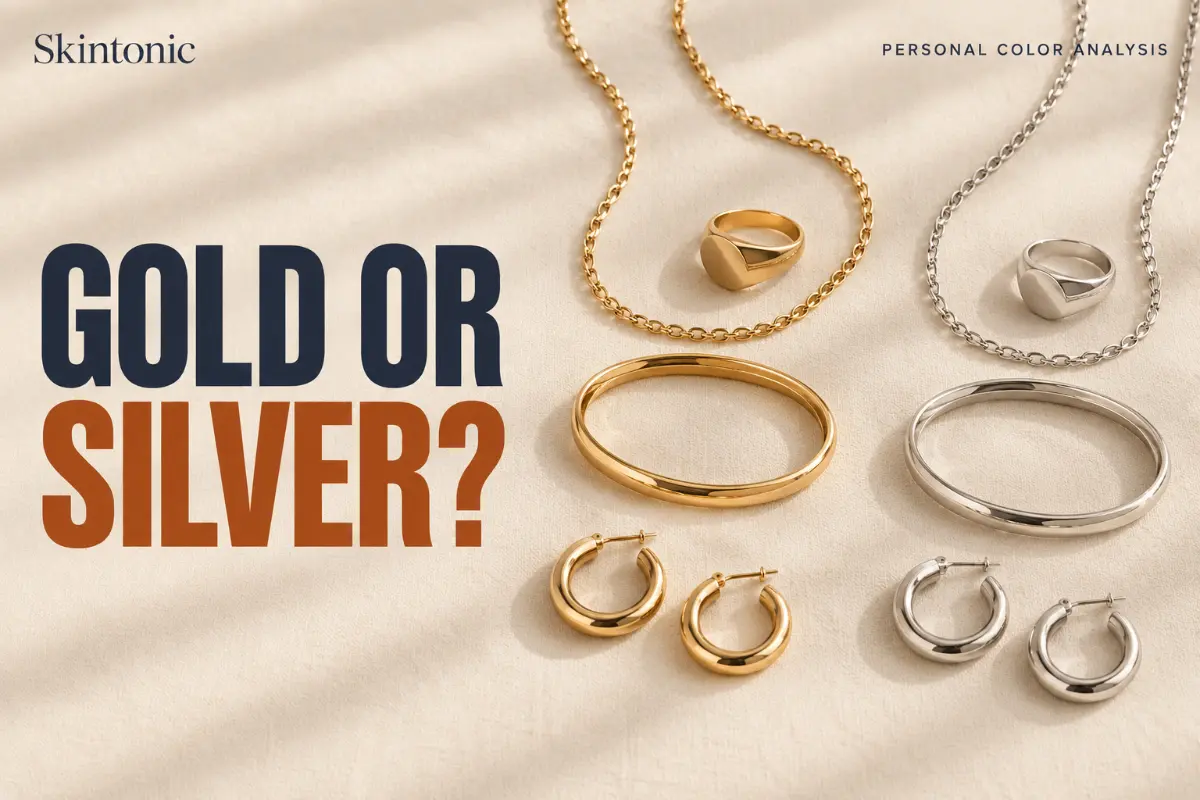
Gold tends to flatter warm undertones, and silver tends to flatter cool ones. If your skin has a golden, peachy or olive-yellow cast, gold usually makes you look warmer and more awake. If your skin leans pink, rosy or bluish, silver, white gold and platinum usually look cleaner and brighter next to your face.
That rule of thumb is a good start, but it isn’t the whole story. Your contrast level, how soft or bright your coloring is, and even the finish of the metal all change the result. This guide walks you through quick ways to test it at home, what to do if both seem to work, and how the answer shifts across the color seasons.
Why metal color matters at all
Jewelry sits right next to your skin, usually at the face, neck, ears and hands. Metals reflect light back onto the skin around them, so a metal that shares your skin’s undertone tends to blend in and add a little glow. A metal that clashes with your undertone can make the skin nearby look slightly sallow, gray or ruddy, in the same way the wrong clothing color can (we cover that effect in colors that make you look tired).
The effect is subtle compared with a large block of color like a shirt or scarf, so don’t panic if you love a piece in the “wrong” metal. But for everyday pieces you wear close to the face, getting it right is an easy win.
How to tell which metal suits you
1. Do the side-by-side test
This is the most reliable at-home check, because it tests the actual thing you want to know.
- Stand by a window in daylight, with no makeup or with very light makeup, and pull your hair back.
- Hold a gold item (a ring, chain or even a gold-colored fabric or foil) against your jaw or neck. Then swap to a silver item of a similar size and shine.
- Look at your skin, not the jewelry. Which one makes your skin look smoother and more even, and which one makes shadows, redness or dullness stand out?
- Repeat a few times, and if you can, ask someone else which looks better before you say what you think.
If one metal makes your face seem to “light up” and the other makes it look flat or tired, you have your answer.
2. Check your undertone
Your undertone is the steady color beneath the surface of your skin, and it doesn’t change with a tan. A few classic clues:
- Warm: veins on the inner wrist often look greenish, skin looks golden or peachy next to pure white paper, and you may tan easily.
- Cool: veins often look blue or purple, skin looks pink or rosy next to white paper, and you may burn more easily.
- Neutral: a mix of both, or no clear lean either way.
These clues are hints, not proof. Vein color is hard to read on deeper skin tones, and sun habits vary for many reasons. For a more structured check, try the undertone test.
3. Look at what you already reach for
Many people already know the answer without realizing it. Think about the jewelry you get complimented on, or the pieces you keep wearing while others stay in the box. That pattern is often more telling than any single test.
Gold vs silver by color season
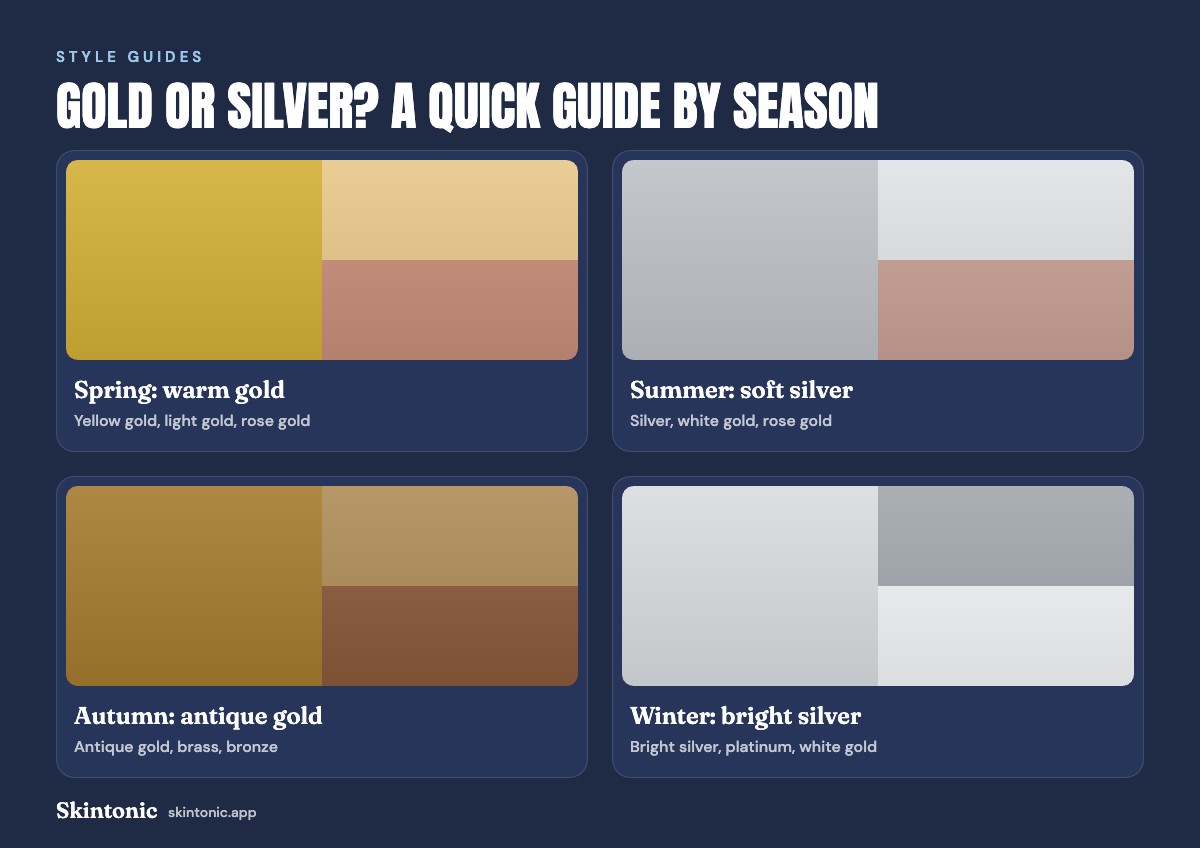
In the 12-season system, your season combines undertone (warm or cool), value (light or deep) and chroma (bright or soft). Undertone mostly decides gold or silver, while value and chroma help decide which version of that metal looks best. If you don’t know your season yet, start with what season am I or browse the 12 seasons overview.
| Season family | Usually best | Finish that tends to work |
|---|---|---|
| Spring (light, warm, bright) | Yellow gold, light gold, rose gold | Polished and shiny; delicate pieces for Light Spring |
| Summer (light, cool, soft) | Silver, white gold, rose gold, pewter | Brushed, satin or soft shine |
| Autumn (soft, warm, deep) | Antique gold, brass, bronze, copper | Matte, hammered or brushed |
| Winter (deep, cool, bright) | Bright silver, platinum, white gold | High polish, crisp and clean |
The seasons closest to neutral are the most flexible. Soft Summer and Soft Autumn can often wear muted rose gold or mixed metals, while Bright Spring and Bright Winter may be able to pull off shiny versions of either metal because clarity matters as much as warmth for them.
Finish and size matter as much as color
Two people who both suit gold might still look best in very different pieces. Your contrast level, meaning the difference between your hair, skin and eyes, is a big clue:
- High contrast (for example very dark hair with light skin, or bright eyes against deep skin): polished, reflective metals and bolder shapes tend to hold their own.
- Low contrast (hair, skin and eyes all close in depth): brushed, satin or antiqued finishes and finer pieces tend to look more balanced. Very shiny, chunky jewelry can overpower you.
- Medium contrast: most finishes work; let your season’s softness or brightness guide you.
Stones and enamel follow the same logic as clothing. A warm season usually looks great in stones like amber, citrine or coral tones, while a cool season often suits pearls with a cool sheen, sapphire-like blues or clear crystal.
What if both metals look fine?
If neither metal clearly wins, you probably have a neutral or near-neutral undertone, or you sit in one of the softer seasons. That’s good news: you have more options. A few ways to make the most of it:
- Try rose gold. Its blend of warm and pink often suits people who sit in the middle.
- Mix metals on purpose. A two-tone ring or a stack of gold and silver bands looks deliberate rather than accidental. Repeating both metals at least twice (for example a watch and a ring) helps it look planned.
- Let your clothes decide. Pick gold when you’re wearing warm shades like camel or olive green, and silver with cooler shades like gray or navy.
Common mistakes to avoid
- Judging under warm indoor light. Yellowish bulbs make everything look golden. Test in daylight.
- Going by hair color alone. Hair color can be dyed, and many cool-undertoned people have golden hair, and the other way around. Test against your skin.
- Comparing different finishes. A shiny silver chain versus a matte gold one tests finish as well as color. Use similar pieces.
- Throwing out pieces you love. Wear the “wrong” metal away from the face (a bracelet, a ring) and keep the right metal for earrings and necklaces.
Find your season first
Choosing jewelry gets much easier once you know your color season, because the same warmth, depth and softness that guide your clothes also guide your metals. Skintonic analyzes one selfie and suggests your color season, with a free preview of the results. You can try it on skintonic.app.
Quick recap
- Warm undertones usually suit gold; cool undertones usually suit silver, white gold or platinum.
- The side-by-side test in daylight is the most reliable way to check.
- Springs and Autumns lean gold; Summers and Winters lean silver.
- High contrast suits polished, bold pieces; low contrast suits brushed, finer pieces.
- If both metals work, try rose gold or mix metals on purpose.
- Keep your best metal near your face and wear the rest on your hands and wrists.


Pingback: What Colors Go With Burgundy? 11 Easy Outfit Pairings
Pingback: What Color Tie With a Navy Suit? 10 Shirt + Tie Combos
Pingback: Warm vs Cool Undertone: How to Tell Which You Have