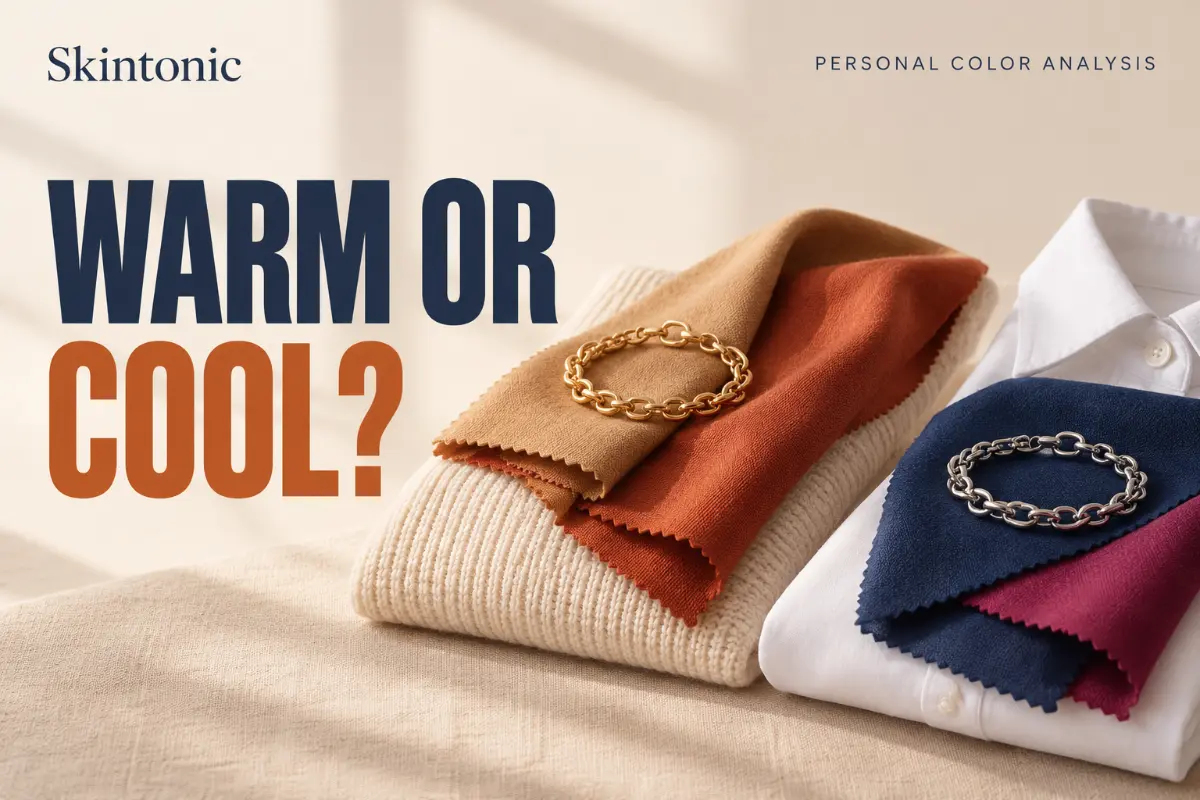
The difference between a warm vs cool undertone is the color that sits under the surface of your skin: warm undertones lean golden, peachy or yellow, while cool undertones lean pink, rosy or bluish. Your undertone tends to stay the same whether you’re pale in winter or tanned in summer, and it’s a big part of why some colors make you glow while others make you look tired.
Below you’ll find the clearest signs of each, examples across fair, medium and deep skin, the mistakes that trip most people up, and where neutral and olive undertones fit in. None of this is hard science; think of it as a practical styling guide that tends to work well when you test it in good light.
Undertone vs skin tone: not the same thing
Skin tone (sometimes called surface tone) is how light or deep your skin is: fair, light, medium, tan, brown or deep. Undertone is the hue underneath. Any skin tone can have any undertone, so a very fair person can be warm and a very deep person can be cool. That’s why “deep skin is always warm” or “pale skin is always cool” are myths worth dropping.
Your surface tone can change with sun, seasons or redness. Your undertone tends to stay put, which is what makes it useful for choosing clothes, jewelry, hair color and makeup.
Warm vs cool undertone: the clear differences
Here’s a side-by-side of the signs people most often use. No single sign settles it; look for the column where most of your answers land.
| Sign | Warm undertone | Cool undertone |
|---|---|---|
| Skin in daylight | Golden, peachy, yellow or caramel cast | Pink, rosy, red-violet or bluish cast |
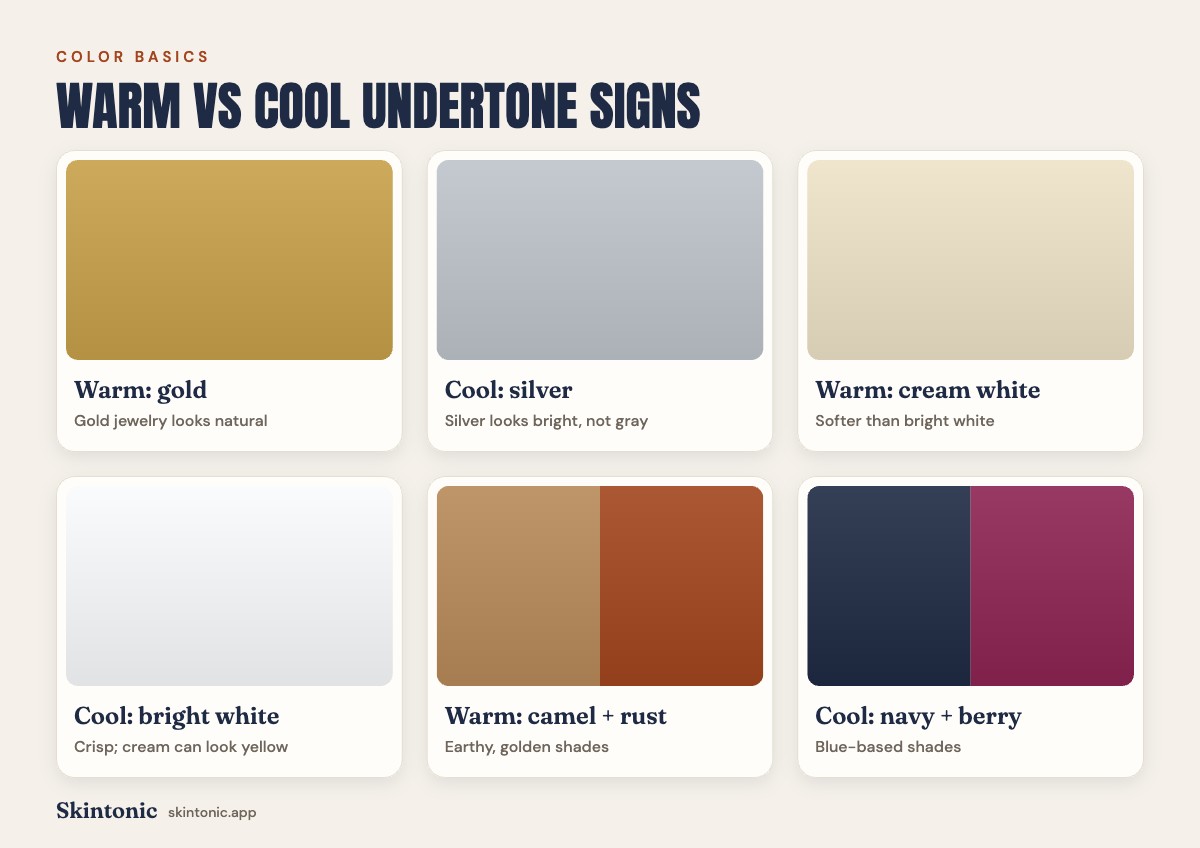
| Jewelry | Gold often looks more natural | Silver and platinum often look more natural |
| White fabric | Cream and ivory look softer and kinder | Bright white looks crisp; cream can look yellowish |
| Sun | Tends to tan easily and go golden | Tends to turn pink or burn first (on lighter skin) |
| Veins on the wrist | Often look greenish | Often look blue or purple |
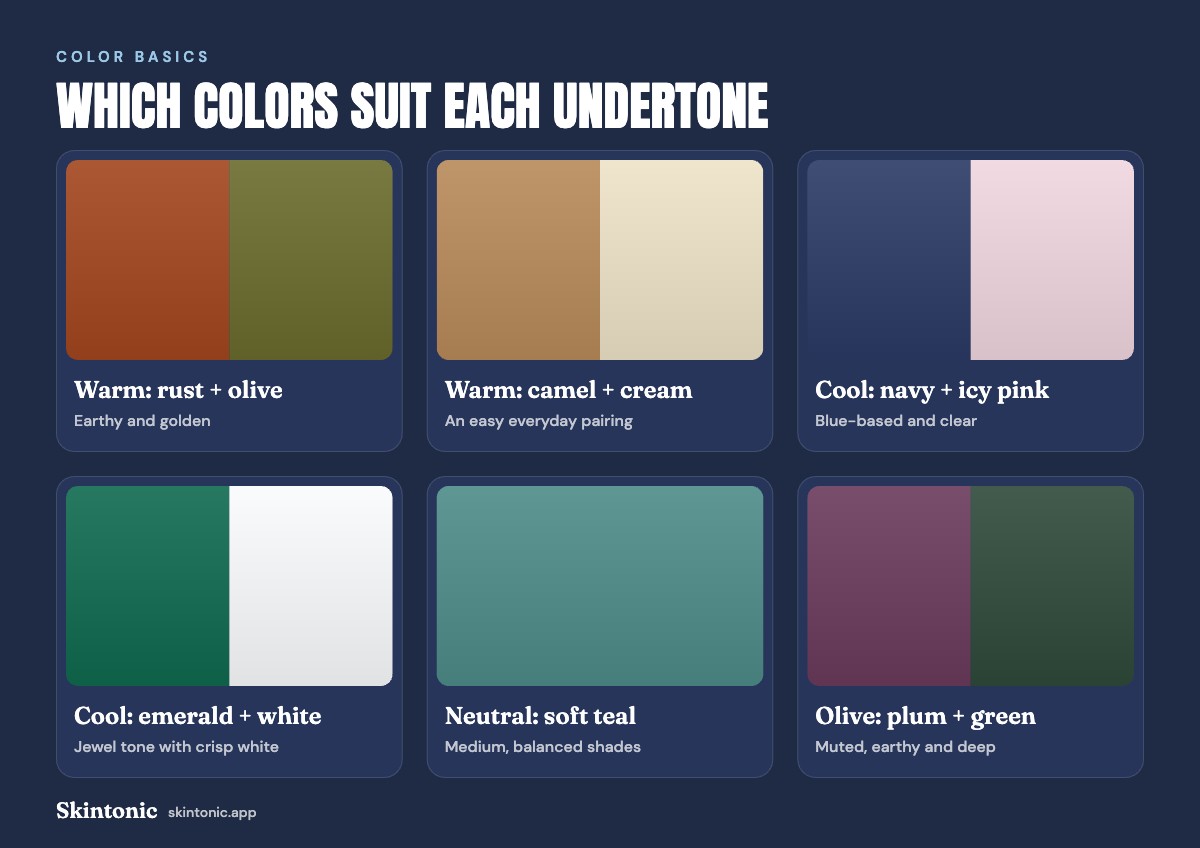
| Flattering colors | Earthy, golden shades: camel, rust, olive, warm red | Blue-based shades: navy, emerald, berry, icy pastels |
| Colors that can drain you | Icy pastels, stark blue-gray | Mustard, orange, khaki |
The vein test is the most famous but also the least reliable, because vein color is affected by skin thickness and lighting. Treat it as a small hint, not a verdict. The jewelry and white-fabric tests near your face tend to be more telling.
Examples across skin tones
Undertones look a little different depending on depth, so it helps to know what each one tends to look like on different skin.
Fair and light skin
- Warm: peachy or golden ivory, freckles that look golden-brown, and often looks best in cream rather than stark white.
- Cool: pink or rosy porcelain, flushes easily, and often looks fresh in bright white, soft rose and navy.
Medium and tan skin
- Warm: golden, honey or caramel, and tends to glow in camel, terracotta and olive.
- Cool: rosy beige or a slightly pink-brown cast, often lifted by berry tones, cool reds and emerald.
Brown and deep skin
- Warm: red-brown, golden or bronze undertones that often come alive in rust, mustard, warm coral and gold jewelry.
- Cool: a blue-red or plum-like cast that often looks striking in jewel tones, true white, fuchsia and silver.
For color ideas by depth and undertone, see colors for medium skin and colors for cool undertones.
How to check your undertone at home
- Use daylight. Stand near a window during the day, without direct sun on your face. Warm indoor bulbs make almost everyone look warmer.
- Go bare. Remove makeup and tinted skincare, and pull dyed hair back if it’s very different from your natural color.
- Do the white test. Hold a bright white towel or shirt under your chin, then a cream or ivory one. If bright white makes you look clear and cream makes you look sallow, you probably lean cool. If cream looks softer and bright white looks harsh, you probably lean warm.
- Try gold vs silver. Hold a gold piece and a silver piece (or gold and silver foil) near your face. Watch your skin, not the metal. There’s more on this in our guide to whether gold or silver looks better on you.
- Compare two fabrics. Try a warm color like rust or camel against a cool one like fuchsia or icy blue. One usually evens out your skin; the other tends to bring out shadows or redness.
If you’d like a guided version, the free undertone test walks you through these checks one at a time.
Common undertone mistakes
- Mistaking redness for a cool undertone. Flushing, sensitivity or rosacea add surface pink. A warm-undertoned person can still have red cheeks, so look at the skin along your jaw and neck too.
- Judging under indoor lighting. Yellow bulbs push everyone warm; some cool LEDs and screens push everyone cool.
- Using a tan or foundation as the guide. A tan deepens your skin tone but doesn’t swap your undertone. A foundation in the wrong shade can make you look warmer or cooler than you are.
- Relying on one test. The vein test especially. Combine several checks and go with the majority.
- Forcing yourself into one box. Plenty of people sit in the middle, which brings us to neutral and olive.
What about neutral and olive undertones?
Neutral undertone
If gold and silver both look fine, and neither bright white nor cream looks obviously wrong, you may be neutral: a balance of warm and cool. Neutral undertones tend to have the widest range, especially with medium-intensity shades like soft teal, dusty rose, jade and true red. The extremes, very icy or very orange, are usually where neutrals notice a difference.
Olive undertone
Olive skin has a greenish, sometimes grayish cast, often over a warm or neutral base. It gets mistaken for warm because it isn’t pink, and for cool because it isn’t obviously golden either. Olive undertones often look great in muted earthy colors, deep greens, plum, teal and soft whites, and can look washed out in very bright pastels. See colors for olive skin for more ideas.
Why undertone is only part of the picture
Undertone tells you whether to lean warm or cool, but it isn’t the whole story. How light or deep your coloring is, how much contrast there is between your hair, eyes and skin, and whether you suit clear or soft colors all matter too. Two people with warm undertones can still look best in very different shades: one in bright coral, the other in muted olive and camel.
That’s what color seasons add on top of undertone. If you’d like to go a step further, the color analysis quiz combines these traits, or you can upload one selfie to Skintonic and get your suggested color season with a free preview. And if certain shades always seem to leave you looking worn out, our post on colors that make you look tired explains why.
Quick recap
- Warm undertones lean golden, peachy or yellow; cool undertones lean pink, rosy or bluish.
- Undertone is separate from skin tone: any depth can be warm, cool, neutral or olive.
- The most useful checks are white vs cream and gold vs silver near your face, in daylight.
- The vein test is a weak hint; don’t rely on it alone.
- Redness, indoor light, tans and foundation are the usual reasons people guess wrong.
- Neutral undertones can wear both sides; olive undertones often love muted, earthy shades.